The Rise of Spatial Audio: Why Everything Is About to Sound Different
For nearly a century, recorded music lived in two dimensions — left and right. Dolby Atmos mixing is not an illusion of space; it is a fundamentally different way of placing sound in physical, three-dimensional space.
Apple Music launched Dolby Atmos streaming in 2021. By 2024, Atmos content on Apple Music alone crossed a billion streams per day. The shift is not coming — it is already here.
For anyone working in music production, audio engineering, or film scoring, understanding immersive audio is quickly becoming a baseline professional skill rather than a specialist niche.
Object-Based Audio vs Channel-Based Audio: The Core Distinction
Traditional stereo is channel-based: every element of your mix is fixed to a left or right position at the point of export, locked permanently.
Dolby Atmos is object-based. Individual sounds — a vocal, a kick drum, a guitar riff — are treated as independent audio objects, each with its own three-dimensional position metadata describing placement across left/right, front/back, and up/down.
The Dolby Atmos renderer interprets that metadata in real time and delivers correct positioning for any playback system — a cinema rig, a 7.1.4 home theatre, stereo speakers, or AirPods with head-tracking. One mix. Every system.
The 7.1.4 Configuration Explained
In surround sound notation, the numbers represent: ear-level speakers, subwoofers, and overhead speakers. So 7.1.4 means seven ear-level speakers, one subwoofer, and four overhead speakers.
The four overhead speakers — two forward, two rear — create a full sphere of sound around the listener rather than a flat plane in front of them.
This means you can now place sounds above a listener with precision. A reverb tail can lift upwards rather than spreading outwards. Done with restraint, height placement changes the emotional character of the listening experience in ways stereo simply cannot replicate.
Why Streaming Platforms Are Betting on Dolby Atmos
Apple Music's Dolby Atmos integration was a watershed moment: for the first time, an Atmos-mixed track played in spatial audio — free — to any listener on Apple hardware. Overnight, millions were experiencing music in three dimensions.
Listeners described feeling like they were inside the music rather than listening through speakers. Artists and labels began commissioning Atmos mixes for back-catalogue releases, not just new music.
Tidal, Amazon Music, and Netflix have all followed with immersive audio infrastructure. Engineers who can mix in Atmos fluently are already commanding premium rates for their work.
What You Can Learn Working in a Dolby Atmos Environment
Working in an Atmos studio forces intentional decisions about height and depth, not just width — deepening your understanding of spatial perception and psychoacoustics considerably.
You develop sensitivity to reverb tails, early reflections, and ambience that is hard to acquire in stereo-only environments. You also learn how high frequencies carry directional information much more precisely than low frequencies.
Atmos work also requires technical precision: the integrated loudness target for Atmos music delivery is -18 LUFS (vs -14 LUFS for standard streaming), and renderer settings, binaural monitoring, and object/bed channel management all demand careful management.
Seven Stones Studio: Rajasthan's First Dolby Atmos Enabled Studio
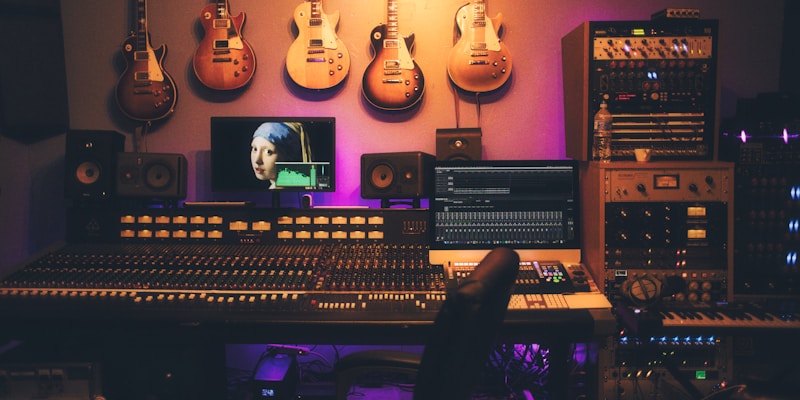
Seven Stones Studio is Rajasthan's first Dolby Atmos enabled studio, built to the full 7.1.4 specification. Every speaker has been positioned, calibrated, and room-corrected for an accurate, consistent listening environment.
Our Advanced Music Production and Film Scoring course integrates Dolby Atmos mixing as a core module — not a brief introduction, but a deep-dive into object-based workflows using industry-standard delivery formats.
The studio also offers mixing and mastering services in Dolby Atmos, with delivery in ADM BWF format suitable for Apple Music and Tidal submission — bringing immersive audio infrastructure to Jaipur that was previously only available in Mumbai, Delhi, or overseas.